Writing Across the Curriculum

“The Rhetorical Situation” and Reading Strategies in Advanced Composition

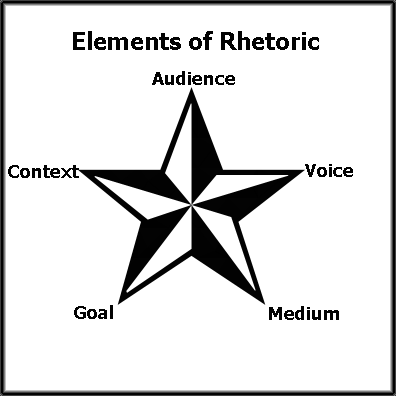
Elements-of-Rhetoric

by: Caitlin Holmes

Caitlin Holmes is the Assistant Director of Writing Across the Curriculum at George Mason University.  She blogs regularly about teaching here at thewritingcampus.com.  You can reach her via email at [email protected].  

During a pre-semester meeting to discuss the QEP assessment findings of Mason’s English 302 Students-as-Scholars Program, instructors of our Advanced Composition courses went over the primary student learning outcomes (SLO):

  • SLO-1, Discovery: Understand how they can engage in the practice of scholarship at GMU
  • SLO-2, Discovery: Understand research methods used in a discipline
  • SLO-3, Discovery: Understand how knowledge is transmitted within a discipline, across disciplines, and to the public
  • SLO-4, Inquiry: Articulate and refine a question
  • SLO-5, Inquiry: Follow ethical principles
  • SLO-6, Inquiry: Situate the scholarly inquiry [and inquiry process] within a broader context
  • SLO-7, Inquiry: Apply appropriate scholarly conventions during scholarly inquiry/reporting

What those discussions reinforced for my colleagues and me is that engagement in scholarship and knowledge transmission requires that students have advanced reading practices that often are not overtly discussed – or are sometimes presumed as proficiencies – as we work on writing competencies.  
Against “The Library Scavenger Hunt”: Better Library Research Assignments

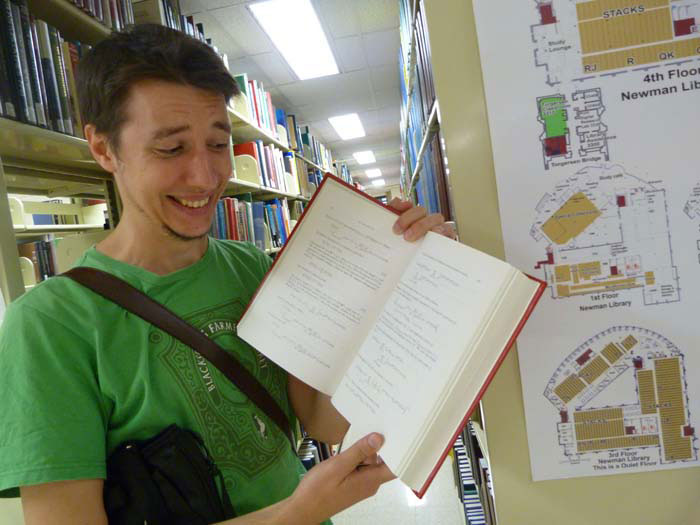
Scavenger Hunt Picture

Jen Stevens is the Humanities and Social Sciences Librarian at George Mason University and a consultant for Mason’s Writing Across the Curriculum Faculty Senate Committee.  She has extensive experience assisting undergraduate and graduate student writers discover new resources and information in their research process.  For her information and current InfoGuides, click here!

In my work as a Humanities and Social Sciences Librarian at George Mason University, I work with faculty members and their students to help the students learn how to do better research, which in turn leads to better writing.

Last week, I found the strangest thing in the Fenwick Library Reference area. . .

Reblog: Writing Without Really Trying

Male hands using iPhone writing a text message

This satirical article appeared on Nick Carbonne’s blog, Odds and Ends, on December 4, 2014.  Nick is the Director of Teaching and Learning for the Bedford/St. Martin’s imprint of Macmillan Education.  His previous academic affiliations include Colorado State University, Marlboro College, UMass-Amherst, Lyndon State College, and Boston College.

We normally think of writing as a very labor-intensive process.  During busy times, how can we look like effective writers, without actually being effective? In Nick Carbonne’s cheeky post, he discusses tips and tricks for writing to appear effective – and perhaps some tricks that students may try to play on faculty as well.  He notes, “On Tuesday I visited a community college in NYC for a meeting with faculty. On the way to the meeting room, we passed clusters of students waiting outside office doors, trails of students following faculty with beseeching eyes, and heard from later arriving faculty that they were delayed by students wanting last minute help, extra time, and all the fun stuff that comes as a semester winds down.”

So, for their sake and maybe yours too, here’s a list of tips and resources you can share w/ students to help alleviate their stress:

#worthassigning: How to Write Effectively without Really Trying

This is cross-genre advice. Feel free to use these tips when sending memos to your supervisor, e-mailing colleagues, working with an author who needs some help, drafting a personal ad, and other places and times when writing makes a difference but you are really too busy to give it much thought.

  1. E-Mail: End all e-mail with “Sent from my iPhone,” or “Sent from Blackberry.”  Research shows that readers of messages with those auto-added advertisements forgive grammar errors and typos more readily:  collision detection: Why people forgive your bad spelling in email “sent from my iPhone”
  2. Georgia, Georgia, the whole document through, just an old sweet font, keep Georgia on your mind, for better grades.  How typeface influences the way we read and think – The Week
  3. If page length matters . . . Triple Space! Graphics!:  http://www.homestarrunner.com/sbemail64.html
  4. Extortion, lying, and sudden endings: tips for getting readers to read:  http://workableweb.com/_pages/tips_how_to_write_good.htm

Read-Around Groups: Low-Stakes and High-Impact Writing in First-Year Composition

 RAGS

By Caitlin Holmes

Since Dr. José Bowen visited Mason in September 2014, I have been working to implement more of his suggestions for teaching practice into my class. I wrote previously about utilizing one such suggestion: a combination of reading, writing in response, and discussion to understand the rhetorical nature of APA style. More recently, I have experimented with another approach to improving student writing in a low-stakes environment that requires students to show the higher-order thinking skills that Dr. Bowen emphasized: read-around groups. During his workshop at Mason, Bowen reminded us that students respond well to uncertainty, failure, and experimentation, and read-around groups (or RAGs, as they are also known) certainly allow for those conditions to emerge in a productive way.

“Teaching in Thin Air” – by Susan Schorn

Everest_kalapatthar_crop

Susan Schorn, writing as a guest on author John Warner’s blog Just Visiting, has written a compelling post on one of the many issues facing writing instruction in the age of the constant budget crisis. In “Teaching in Thin Air,” Susan illustrates the direct link between higher class caps in writing classes and student drop-out rates, negative evaluations, and teacher burnout. To diffuse a teacher’s attention in a writing classroom, she points out, is to guarantee minimal writing instruction for each student.

“Though I’ve never climbed Everest, I’ve spent considerable time in academia’s version of the death zone: the super-sized writing classroom. I’ve taught writing-intensive courses in “overflow” sections with 26 students or more; I’ve worked with instructors who regularly taught sections of 32, 40, or even 60 students. Of course, “teach” is probably the wrong verb—any instructor who has helmed one of these mega-classes knows it’s virtually impossible to teach the students much about writing. There simply isn’t enough instructional oxygen to sustain learning.”

“Teaching in Thin Air” –  by Susan Schorn