Writing Across the Curriculum

Responding to Student Writing/Writers

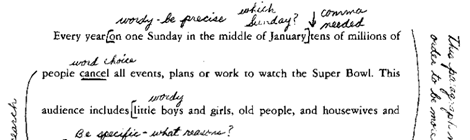
Teaching and Learning in Higher Ed. highlights some of the best practices from Nancy Sommers’ new book, Responding to Student Writers. One of the most helpful insights is the ability to recognize that our comments to students may be contradictory, misleading, or vague, and that the real purpose of offering feedback to students is to “teach one lesson at a time.”

“We should ‘ask ourselves: What single lesson do I want to convey to students through comments? And how will I teach this lesson?'”


Students as Teachers – Professor/Student Collaboration Improves a History Course

writing-history

In a recent post from Bryn Mawr’s Teaching and Learning Together in Higher Education, Professor Alejandro Quintana, Assistant Professor in the History Department at St. John’s University, and his student Writing Fellow, Morgan Zajkowski, have written an excellent blog post detailing their work together. Over the course of a semester, Quintana and Zajkowski collaborated on ways to improve student writing, retention, and participation in Quintana’s history course, guided by the principles of WAC. They offer helpful insights into fostering student engagement and making the classroom a dynamic place for collaborative discussion, while using low-risk writing assignments to build student confidence.

“I expected at some point to be forced to say no to any major suggestion to change my teaching practices. To my great surprise this never happened; our collaboration was progressive and smooth. Before I realized it, we were making significant changes to my teaching methodology. I learned so much from Morgan and my teaching practices were reshaped for the better. Today, a year after our collaboration, I have incorporated into all my current courses all the activities and assignments she helped me develop during the spring semester of 2013.”

“Students as Teachers Transforming a History Course”  – Alejandro Quintana and Morgan Zajkowski

Write Nerdy to Me: Utilizing Fanfiction in WAC/WID Courses

Fan Fiction 1
By Caitlin Dungan

Caitlin Dungan is a PhD student in Mason’s Writing and Rhetoric PhD Program. Caitlin is a Graduate Research Assistant for Mason’s Writing Across the Curriculum Program, and her current research interests include fanfiction, digital media and rhetoric, online feedback practices, and participatory culture.

It’s interesting, perplexing, and – I think – exciting that geek culture has emerged as mainstream. Realms previously reserved for a few indoctrinated fans are now open for participation to the many. One of the side effects of this growth in fandoms is the increasing number of emergent writers embracing fanfiction as a creative outlet. As young fans pursue this unique composition practice and post their works on online forums like fanfiction.net or Archive of Our Own, how much of this self-sponsored writing is informing their writing practice in the classroom?

Combating the “Kids Today” Trope in Student Writing

istock_000018223031xsmall

Nick Carbone, Director of Teaching and Learning for Bedford/St. Martin’s, discusses the tendency of faculty to view their incoming students as progressively less skilled than in years past. He gives several reasons why, despite how it may appear, the written word is not necessarily in decline.

“There was no magical time when students arrived at college as literate and able as faculty imagined students used to be when the faculty were students themselves…Things are not getting worse. In many ways, since students are writing more in their everyday lives, things are getting better.”

“Faculty Who Diss Student Writing Under the ‘Kids Today’ Trope Forget That They Were Students” – Nick Carbone 

An Attempt at “Teaching Naked”: Implementing José Bowen in ENGH 302

raisinghands1

By Caitlin Holmes

Caitlin Holmes is the Assistant Director of Writing Across the Curriculum at George Mason University.  She blogs regularly about teaching here at thewritingcampus.com.  You can reach her via email at [email protected].  

Dr. José Bowen, President of Goucher College and author of Teaching Naked, came to George Mason’s Innovations in Teaching and Learning Conference sponsored by the Center for Teaching and Faculty Excellence on September 18-19. During his visit, he led a 4-hour long workshop and then delivered a keynote presentation. During his presentations, Dr. Bowen spoke passionately about the importance of integrating technology more effectively into and out of the classroom as a way to encourage student accountability for learning and – most importantly – to transform the classroom into a site of thinking, not just knowledge acquisition.