Writing Across the Curriculum

Mason’s WAC program profiled in piece on “High Impact Practices”

From the piece by Christopher J. Gearon in US News and World Reports:

“There is a clear connection between writing and students’ critical thinking skills,” says Michelle LaFrance, director of the Writing Across the Curriculum program at George Mason University in Virginia. Students who spend time perfecting the type of writing required by their disciplines “make better connections with one another and faculty, and they learn more deeply.”

Read the full article here:
http://www.usnews.com/education/best-colleges/articles/2015/09/23/colleges-take-aim-at-improving-student-success

Commenting Strategies

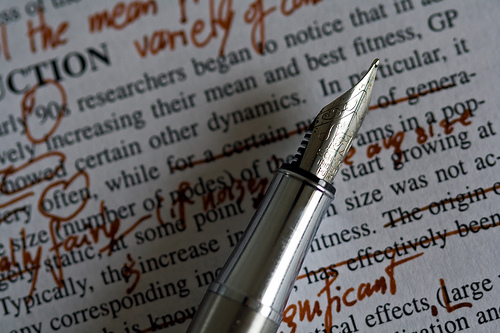
Check out this easy video for speeding up commenting on student work!  It’s a great complement to Paul T. Corrigan’s essay  on correcting student work.  How do you give feedback to students?  What works for you?

VIDEO: Principles for Assignment Design

Mason WAC’s learning module on best practices for writing assignment design in any discipline!

Elaborated Assignment
Unelaborated Assignment
Assignment Design Principles

How to Be a Better Writer – 6 Tips from Harvard’s Steven Pinker

man-scribble-yellow-lightbulb-head-600x600

Though writing is certainly one of the most complex acts humans engage in, sometimes it helps to boil the crafting of writing down to its most basic elements. When it comes to good writing, the essentials go beyond process and repetition and into the realm of psychology. Time’s Eric Barker interviewed Steven Pinker, of Harvard’s Department of Psychology, on what he considers to be the best tips for better writing. These helpful strategies are deceptively simple: things like “Don’t assume your reader knows what you already know.”

“…another bit of cognitive science that is highly relevant is a phenomenon called ‘the curse of knowledge.’ Namely, the inability that we all have in imagining what it’s like not to know something that we do know. And that has been studied in various guises in the psychological literature. People assume that the words that they know are common knowledge. That the facts that they know are universally known… the writer doesn’t stop to think what the reader doesn’t know.”

How to Be a Better Writer: 6 Tips from Harvard’s Steven Pinker

Feedback and Revision – A Module from Eli Review

2756494307_a0380a96e0

Today we are highlighting a helpful module from Eli Review on how to understand, use, and teach informative feedback strategies and in-depth revision. Timely and explicit feedback from both teachers and peers leads not only to improved drafts, but to improved writing skills overall. Giving students the instruction they need to learn reflective skills for analyzing both their own writing and their peers’ is critical to fostering the confidence of emerging writers.

“Teaching and learning don’t happen in a vacuum. They happen within specific schools, classrooms, and cultural contexts. This is true for feedback as well.

Effective feedback requires a context in which learners have both the ability and opportunity to hear, understand, and act on that feedback. We might think about feedback rich classrooms as “safe and smart” learning contexts, or classroom communities in which students feel comfortable enough to risk engaging and learning with each other.”

Feedback and Revision: The Key Components of Powerful Writing Pedagogy